7 days free, no card. Then P2,500 once for 12 months of full access.
Interactive course map
Pick a module
See what you will be able to do, the paragraphs behind each outcome and the part that teaches it.
Module 1Free in the trial
Overview, scope and why IFRS 18 replaces IAS 1
See what IFRS 18 changes and what it leaves alone: scope, the complete set, the general requirements carried over from IAS 1, and a retailer's statement of profit or loss before and after.
M1.O1Explain why IAS 1 is replacedExplain the investor problems that led the IASB to replace IAS 1, the three improvements IFRS 18 makes, its effective date, and why recognition and measurement do not change.IFRS 18.1, 4, C1 · Understand
M1.O2Decide whether IFRS 18 appliesDetermine whether IFRS 18 applies to a given report or statement, including condensed interim statements, management commentary and entities without IAS 32 equity.IFRS 18.2, 3, 5, 6, 7, 8 · Apply
M1.O3Apply the general requirementsList the statements that make up a full set and apply the general requirements on identification, equal prominence, frequency, consistency, comparatives and the third statement of financial position.IFRS 18.10, 11, 14, 25, 28-34, 37-40 · Apply
M1.O4Trace where IAS 1 movedTrace where each part of IAS 1 now sits (IFRS 18, IAS 8 or IFRS 7) and identify what carried over unchanged, including the IFRS 19 reduced-disclosure link.IFRS 18.C8, 96-112, 113, 126-132; IAS 8.6A-6N; IFRS 7.19A-19B; IFRS 19.163 · Understand
M1.O5Compare a retailer before and afterCompare a retailer's IAS 1 statement of profit or loss with its IFRS 18 version and identify the lines that move between categories, the new subtotals and the profit that stays the same.IFRS 18.47, 52, 53(a), 69; IAS 1.81A; IAS 1.82(b) · Analyse
LearnStudy Course Module 1 and its 20-question knowledge check
ReadTraining Manual chapter 1
BuildDisclosure Studio ST-02
ApplyWorkbook WB-M1-1, WB-M1-2, WB-M1-3
ProveRevision Kit Module 1 questions and the mocks
Classify every income and expense into one of the five categories: operating as the residual, investing and financing by their tests, income taxes and discontinued operations as fixed boxes, plus FX, derivatives and derecognition.
M2.O1Classify into five categoriesClassify income and expenses into the five categories, applying operating as the residual category and the fixed income taxes and discontinued operations categories.IFRS 18.46, 47, 49, 52, 67, 68, B42 · Apply
M2.O2Place investing itemsDetermine which income and expenses belong in the investing category for associates and joint ventures, cash and cash equivalents and stand-alone return assets, including incremental acquisition and disposal costs.IFRS 18.53, 54, 56, B45-B49, B55(c) · Apply
M2.O3Separate finance-raising liabilitiesDistinguish liabilities from transactions that only raise finance from other liabilities, and classify the related income and expenses in financing or operating.IFRS 18.59-61, 64, B50-B55, B58 · Apply
M2.O4Treat exchange and hedging itemsApply the classification rules for foreign exchange differences, derivatives and hedging instruments, the net monetary position, derecognition gains and losses and changes in use.IFRS 18.62, 63, B60-B76 · Apply
M2.O5Sort a full list of itemsAnalyse a retailer's or manufacturer's list of income and expenses, sort it into category totals and justify each judgement.IFRS 18.47, 52-61 · Analyse
LearnStudy Course Module 2 and its 20-question knowledge check
ReadTraining Manual chapter 2
BuildDisclosure Studio ST-02, ST-03
ApplyWorkbook WB-M2-1, WB-M2-2, WB-M2-3, WB-M2-4
ProveRevision Kit Module 2 questions and the mocks
Decide whether an entity invests in assets or finances customers as a main business activity, then apply the different category rules and templates for investors, banks and lenders, and insurers.
M3.O1Spot a main business activityDecide whether an entity carries on a specified main business activity, using the evidence indicators at reporting-entity level, and state what it discloses, including on a change in the assessment.IFRS 18.49-51, B30-B37, B41 · Apply
M3.O2Classify for investing entitiesClassify the income and expenses of an investing entity, including investee results, stand-alone return assets and income on cash.IFRS 18.55, 56(a), 58, B38-B40, B43, B44(b) · Apply
M3.O3Apply customer-financing rulesApply the customer-financing rules to a bank or lender: finance-raising liabilities and the policy choice, other liabilities, cash, derivatives, and the knock-on effect on the second required subtotal.IFRS 18.56(b), 57, 65, 66, 73, 74, B48(c), B59 · Apply
M3.O4Classify an insurer's itemsClassify an insurer's income and expenses, including insurance finance income and expenses, investment income and the IFRS 17 line items, and identify its gross-profit-like subtotals.IFRS 18.64(b), 75(c), B31(c), B123(c), B123(d) · Apply
M3.O5Compare sector templatesCompare the statement of profit or loss templates of a manufacturer, a manufacturer that finances customers, an insurer and a bank, and identify which subtotals each presents and why.IFRS 18.69, 73, IE9-IE13 · Analyse
LearnStudy Course Module 3 and its 20-question knowledge check
ReadTraining Manual chapter 3
BuildDisclosure Studio ST-01, ST-04, ST-05, ST-06
ApplyWorkbook WB-M3-1, WB-M3-2, WB-M3-3, WB-M3-4
ProveRevision Kit Module 3 questions and the mocks
Build the three required totals line by line, know when a lender loses one, apply the required line items and test any extra subtotal management wants.
M4.O1Calculate the required subtotalsCalculate operating profit, profit before financing and income taxes and profit from a list of categorised income and expenses.IFRS 18.69-72 · Apply
M4.O2Know when to omit the second subtotalDetermine when an entity must not present profit before financing and income taxes and which alternative subtotal and label it may use.IFRS 18.73, 74 · Apply
M4.O3Identify required line itemsIdentify the line items IFRS 18 requires in profit or loss, including IFRS 9 lines and lines that appear in more than one category, and what happens to a required line that is not needed.IFRS 18.23, 75(a), 75(b), B8, B77 · Apply
M4.O4Test a proposed extra subtotalEvaluate whether an additional subtotal or line item proposed by management meets the IFRS 18 conditions, and where attribution to owners and non-controlling interests sits.IFRS 18.22(a), 24, 76, B9; IAS 1.85; IAS 1.85A · Evaluate
M4.O5Reconcile IAS 1 and IFRS 18 totalsAnalyse the difference between an entity's IAS 1 totals and its IFRS 18 totals and explain the change in the operating figure.IFRS 18.53(a), 55(a), 69-74; IAS 1.81A · Analyse
LearnStudy Course Module 4 and its 20-question knowledge check
ReadTraining Manual chapter 4
BuildDisclosure Studio ST-02, ST-04
ApplyWorkbook WB-M4-1, WB-M4-2, WB-M4-3, WB-M4-4
ProveRevision Kit Module 4 questions and the mocks
Find the measures management quotes that are MPMs, test any rebuttal, and build the single MPM note with a reconciliation, tax and NCI effects.
M5.O1Test the MPM definitionDetermine whether a measure is an MPM by testing the definition: a subtotal, used in public communications for the same period, conveying management's view of the whole entity, and not a listed subtotal.IFRS 18.117, 118, B113-B123 · Apply
M5.O2Test the presumptionEvaluate whether the presumption that a publicly communicated subtotal gives management's view has been rebutted with reasonable and supportable information.IFRS 18.119, 120, B124-B131 · Evaluate
M5.O3Prepare the MPM notePrepare the MPM note: label and description, usefulness, calculation method, the reconciliation to the most directly comparable subtotal, how tax effects were found, and where the note sits.IFRS 18.121-123, B132-B140 · Apply
M5.O4Calculate tax and NCI effectsCalculate the income tax and non-controlling-interest effects of each reconciling item using a stated tax method, and show the reconciling amounts per line item.IFRS 18.123, B136-B142 · Apply
M5.O5Handle changes and interimsApply the requirements for changes to MPMs, MPMs in interim statements and additional per-share amounts, and recognise when an entity has no MPM.IFRS 18.5, 124, 125, B113; IAS 33.73B; IAS 33.73C; IAS 34.16A(m) · Apply
LearnStudy Course Module 5 and its 20-question knowledge check
ReadTraining Manual chapter 5
BuildDisclosure Studio ST-09
ApplyWorkbook WB-M5-1, WB-M5-2, WB-M5-3, WB-M5-4
ProveRevision Kit Module 5 questions and the mocks
Aggregation, disaggregation and the roles of statements and notes
Decide what goes on the face and what goes in the notes, group and label items faithfully, choose nature or function for operating expenses, prepare the nature note, and present the balance sheet and OCI.
M6.O1Decide face or notesDecide whether information belongs on the face of a primary statement or in the notes using their roles and materiality, and organise the notes systematically.IFRS 18.15-20, 114, 116, B1-B3, B112 · Apply
M6.O2Aggregate, disaggregate, labelApply the aggregation, disaggregation, labelling and offsetting principles, including when and how the label 'other' may be used.IFRS 18.41-45, B17, B21-B28, B78, B79 · Apply
M6.O3Choose nature, function or mixedDetermine the presentation of operating expenses by nature, by function or mixed, and when cost of sales must be presented separately.IFRS 18.78-82, B80-B83, B85; IAS 1.99; IAS 1.104 · Apply
M6.O4Prepare the nature notePrepare the expenses-by-nature note required when any operating line is presented by function, including IFRS 9 and IFRS 17 lines.IFRS 18.83-85, B84 · Apply
M6.O5Present financial positionPresent the statement of financial position (current/non-current or liquidity order, required lines including goodwill, covenants) and the OCI section (two groups, reclassification adjustments, tax).IFRS 18.86-104, B91, B100, B106 · Apply
LearnStudy Course Module 6 and its 20-question knowledge check
Assemble and review complete IFRS 18 statement sets for a retailer, an insurer, an investment entity and a bank, each shown before (IAS 1) and after (IFRS 18).
M7.O1Prepare a retailer's statementPrepare a retailer's IFRS 18 statement of profit or loss from its IAS 1 statement, showing the lines that move and the new subtotals.IFRS 18.47, 52, 53, 59-61, 69, 78, B65; IAS 1.82(b); IAS 1.99 · Apply
M7.O2Prepare insurer and investment statementsPrepare the statements of profit or loss of an insurer and an investment entity and explain how each differs from its IAS 1 presentation.IFRS 18.55(b), 56(a), 58, 64(b), 75(c), B44(b) · Apply
M7.O3Prepare a bank's statementPrepare a bank's statement of profit or loss that omits the second required subtotal, and its liquidity-order statement of financial position.IFRS 18.65, 73, 96, B91 · Apply
M7.O4Assemble the complete setAssemble the rest of the complete set: comprehensive income, financial position with the goodwill line, changes in equity and the notes the examples illustrate.IFRS 18.10, 83, 86-112, 122 · Apply
M7.O5Review a draft setEvaluate a draft IFRS 18 statement set and identify classification, subtotal, label and disclosure errors.IFRS 18.43, 69-74, B25, B26, 83, 122 · Evaluate
LearnStudy Course Module 7 and its 20-question knowledge check
ReadTraining Manual chapter 7
BuildDisclosure Studio ST-06, ST-08, ST-12
ApplyWorkbook WB-M7-1, WB-M7-2, WB-M7-3
ProveRevision Kit Module 7 questions and the mocks
IAS 7 and consequential amendments, transition and developments
Rebuild the statement of cash flows from operating profit, classify interest and dividends by entity type, map the consequential amendments, plan transition and track developments.
M8.O1Build the operating cash flowPrepare the operating section of a statement of cash flows starting from operating profit, and classify interest and dividends for an ordinary entity that has no specified main activity.IFRS 18.3, App D; IAS 7.18(b); IAS 7.20; IAS 7.33A; IAS 7.34A · Apply
M8.O2Classify interest and dividendsDetermine the cash-flow classification of interest and dividends for banks, insurers and investment entities that follow their profit-or-loss categories.IFRS 18.App D; IAS 7.34B; IAS 7.34C; IAS 7.34D · Apply
M8.O3Summarise consequential amendmentsSummarise the consequential amendments IFRS 18 made to IAS 8, IAS 33, IAS 34, IFRS 7 and the IFRS 19 interaction.IFRS 18.C8, App D; IAS 8.54J; IAS 33.73B; IAS 34.16A(m); IFRS 7.44KK; IFRS 19.163 · Understand
M8.O4Apply transition rulesApply the transition requirements: effective date, retrospective application, the comparative-year reconciliation, first-year interim statements and the IAS 28 election.IFRS 18.C1-C7 · Apply
M8.O5Explain the current statusExplain the current status of IFRS 18 and the disclosures and regulator expectations that apply before adoption.IFRS 18.C1; IAS 8.30; IAS 8.31 · Understand
LearnStudy Course Module 8 and its 20-question knowledge check
ReadTraining Manual chapter 8
BuildDisclosure Studio ST-10, ST-11, ST-13
ApplyWorkbook WB-M8-1, WB-M8-2, WB-M8-3, WB-M8-4
ProveRevision Kit Module 8 questions and the mocks
1Learn: Study Course module. Open the module. Read the at-a-glance page and the worked example, then take the knowledge check. You get: The rule in plain words and your first score.
2Read: Training Manual chapter. Read the matching chapter. Follow the paragraph references and the application features. You get: Depth, and the exact paragraphs to cite at work.
3Build: Disclosure Studio exercise. Sort the lines, build the subtotals or draft the note, then press Check. You get: A statement or note built right, with instant feedback on each line.
4Apply: Workbook task. Do the task in the Excel template, then compare your work with the model answer. You get: A working paper you can reuse for your own company.
5Prove: Knowledge check, Revision Kit, mock. Pass each module's knowledge check, revise with the kit, then sit a mock. You get: Evidence you are ready, and the Certificate of Completion when every module is passed.
6Implement: Readiness checklist. Run the readiness checklist against your own company's statements and plan the changes. You get: A clear list of what your company must change, and who does it.
Who it is for
Pick your role, see the modules to lean on
Preparers
Sort every line into its category, build the new subtotals and prepare the statements and notes.
1Check. A 20-question knowledge check in every module, pass mark 60 percent, instant feedback with paragraph references.
2Revise. Revision Kit questions by module, then two mock assessments.
3Receive. Certificate of Completion and transcript.
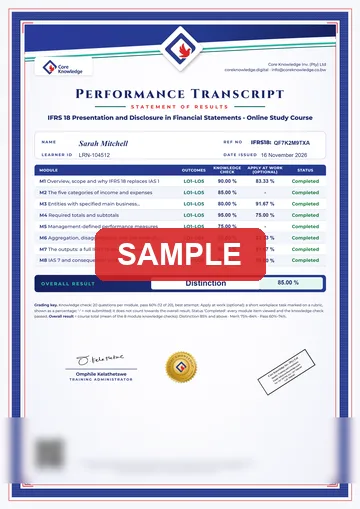
When do I get my certificate? When you have passed the knowledge check in every module (60 percent or more). Your Certificate of Completion and transcript, issued by Core Knowledge, then become available in the course. It confirms completion of a Core Knowledge course; it is not an accreditation or a CPD-hours statement.
Certificate (sample)Transcript (sample)
Samples: names and figures are illustrative.
Free and paid
What the trial opens
Locked items stay visible in the course, so you can see everything the programme adds.