coreknowledgedigital@gmail.comEmail us+267 76 066 483 ACCA · CIMA exams
CoursesFor organisationsHow it worksShopAboutHelpACCA · CIMA examsLearning portal (log in)Track an order Get notified: CBE Made Simple

Delivering digital learning — enabling access without borders.

Kenya · Short course · Self-paced

CBE Made Simple: A Guide for Parents, Learners and Teachers (Kenya)

CBE = Competency-Based Education. Understand the new system in plain English, in six short modules.

Know where your child, or your class, is on the path from 8-4-4 to CBE, read results and rubrics with confidence, and choose the next step with facts.

Launching soonOptional Train the Trainer pack

Independent guide to Kenya's CBE, built from public sources. For official updates, see the Ministry of Education, KICD and KNEC.
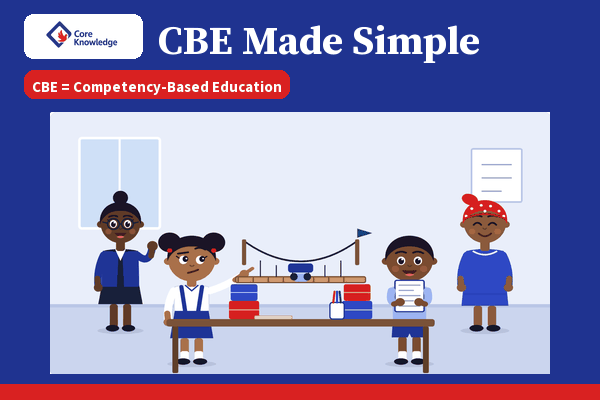
CBE Made Simple course card: Core Knowledge logo and a cartoon classroom of a teacher and learners
  • Parents
  • Learners
  • Teachers
Modules6 short modules
TimeAbout 3 to 4 hours
DevicePhone or laptop
Quizzes15 questions each
OpeningDate to be announced
Made for three readers

One course, a clear path for each of you

Parents

Read each module with your child. Know the next step, the dates and the questions to ask.

Learners

Go at your own pace on your phone. Try the workbook and check your answers with the quiz.

Teachers

Use the one-page summaries to prepare short sessions and answer parents with dated facts.

Course at a glance

What you get, and how it works

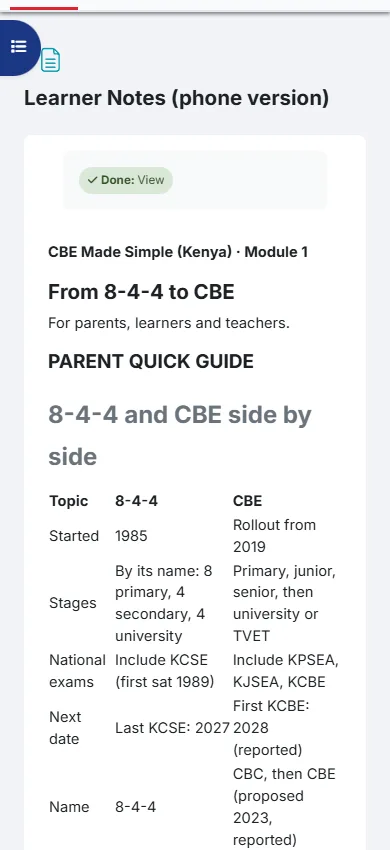
  • Learner notesA short, plain-English read for every module.
  • Phone editionLight on data, easy to read on a small screen.
  • WorkbookTry it yourself, with space to write.
  • One-page summaryThe module on a single page.
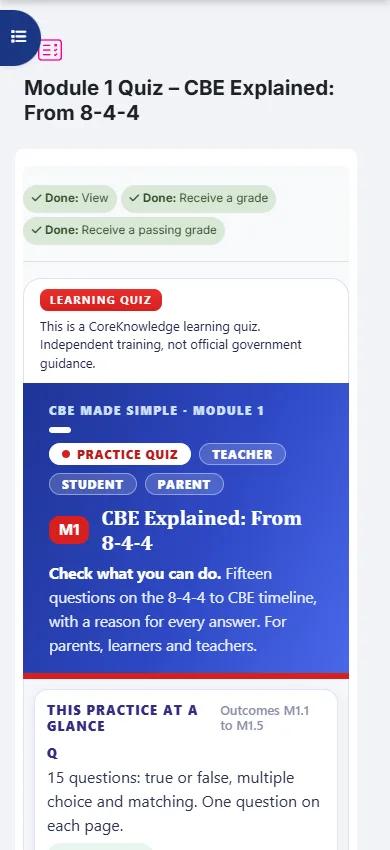
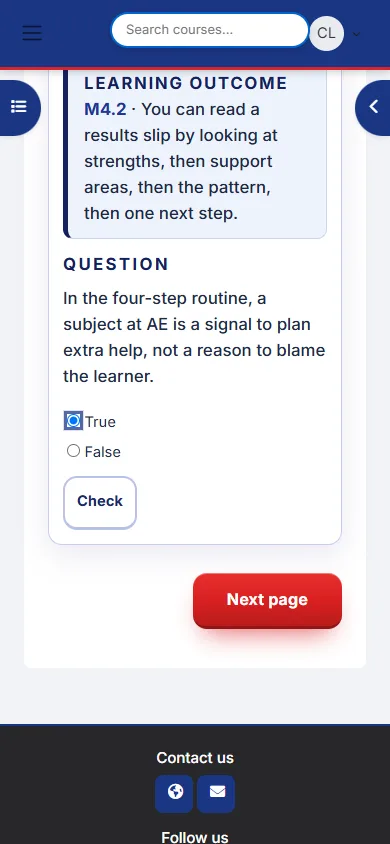
  • Quizzes15 questions per module, instant feedback, unlimited attempts, pass mark 11 of 15.
  • Companion textbookThe whole guide in one book, for reading offline or printing.
  • Train the Trainer packOptional: a facilitator guide and ready kits to explain CBE to others.
  • Certificate (planned)A Core Knowledge certificate of completion is planned; rules to be confirmed.
Quick check · 5 questions · about 3 minutes

Quick check: how well do you know CBE?

Five short questions for parents, learners and teachers in Kenya. Every fact is labelled confirmed, reported or not yet confirmed, just as in the course. No sign-up needed.

See inside

Your journey, step by step

Real screens from the course, shown on a phone.
A clear welcome page lists the six modules and the three outcomes you work towards.
1. Start hereA clear welcome page lists the six modules and the three outcomes you work towards.
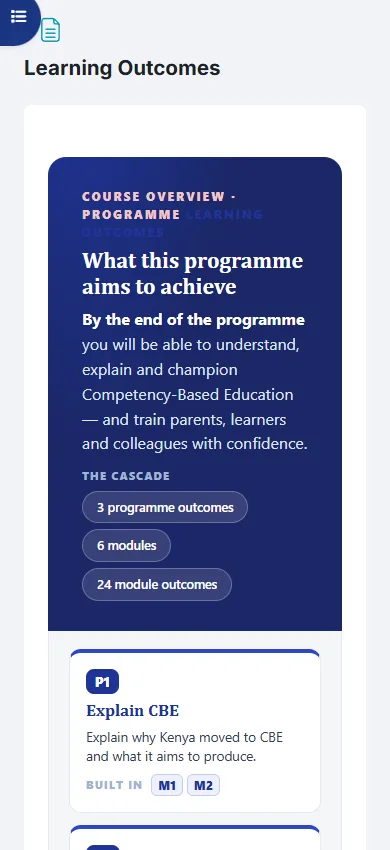
Outcomes

What you will be able to do

Thirty practical outcomes, five in each module.

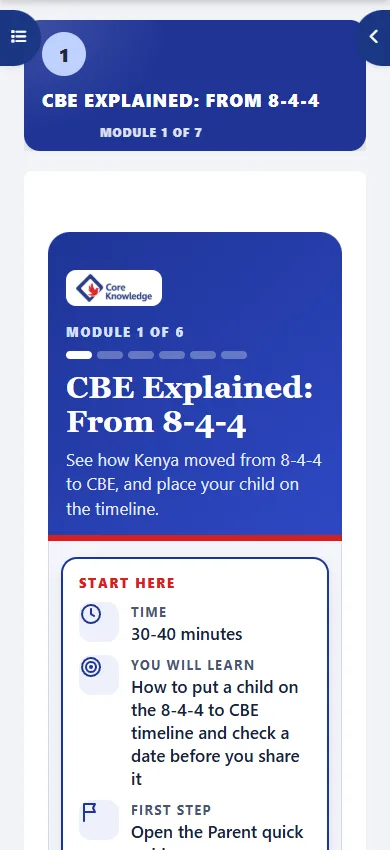
1CBE Explained: From 8-4-45 outcomes
  1. M1.1Place a child on the timeline: which system, which national step is next, and in which year.
  2. M1.2Put the main steps of the reform in order, from the 2011 to 2012 task force to the first CBE learners at university and TVET.
  3. M1.3Explain how CBC and CBE are related and what the 2023 working party report proposed (as reported).
  4. M1.4Compare 8-4-4 and CBE on structure, national assessments and what counts in a learner's record.
  5. M1.5Answer a rumour or worry with dated facts, and say what is not yet confirmed.
2Competencies & the CBE Classroom5 outcomes
  1. M2.1Name the seven core competencies and say each one in everyday words.
  2. M2.2Spot which core competency a task at school or an action at home builds.
  3. M2.3Explain what the curriculum aims for (vision, mission, eight values) and that the number of learning areas was cut (reported).
  4. M2.4Describe how work is checked in a CBE classroom: school tasks scored by teachers (SBA), and national tests at the end of Grade 6 and Grade 9.
  5. M2.5Choose a helpful way to support a project, and link it to the competencies, the values and what reports say about costs.
3CBE Assessment: How Learning Is Checked5 outcomes
  1. M3.1Tell apart school-based assessment and national assessments: what each is, who scores the school tasks, and when.
  2. M3.2Trace the assessment line from Grade 3 to Grade 12: Assessment Number, KPSEA, KJSEA and KCBE.
  3. M3.3Read a rubric: in each row, match the work to the highest level it fully meets.
  4. M3.4Turn a rubric result into feedback: one strength, the next level up, and one next step.
  5. M3.5Decide what to check, and whom to ask, when a level looks wrong or scores seem missing.
4KJSEA Results & Grading5 outcomes
  1. M4.1Turn a KJSEA performance level (EE1 to BE2) into its points and its score range.
  2. M4.2Read a results slip by looking at strengths, then support areas, then the pattern, then one next step.
  3. M4.3Explain what points and totals mean (out of 72, not a percentage) and what KJSEA covers.
  4. M4.4Describe how results link to the three senior school pathways and to Grade 10 placement, and say what is not yet confirmed.
  5. M4.5Choose a calm next step after a result: praise strengths, ask for a support plan, know where reassessment fits.
5Grade 10 Pathways & Placement5 outcomes
  1. M5.1Name the three senior school pathways and say which details about them are not yet confirmed.
  2. M5.2Explain how a learner moves from the KJSEA result to a Grade 10 place, and why the placement split is not yet confirmed.
  3. M5.3Use four questions (like, good at, offered, leads to) to compare pathways for one learner.
  4. M5.4Solve a pathway problem step by step: pressure from friends, a wish to switch, or a cost worry.
  5. M5.5Name what is known about life after school (colleges, TVET, universities) and the questions to ask.
6CBE in Action: Gaps & Next Steps5 outcomes
  1. M6.1Name the gaps that reports describe (Mathematics results, family costs, teacher preparation, books, the Grade 10 start) and say how sure each report is.
  2. M6.2Separate what is reported from what is a rumour or not yet confirmed, including progress as well as gaps.
  3. M6.3List the reported developments and their dates (2026 to 2029) and mark each as reported or not yet confirmed.
  4. M6.4Choose one practical step for your own role to take this term.
  5. M6.5Decide where to get help: who to ask first, which document to read, and which official source to check.
Enrol

Get ready for launch

Launching soon. The opening date and the price are not set yet. Nothing to pay today.
  • Notify me: one email on opening day
  • Invoice or group quote: for families, schools and organisations
  • Questions? WhatsApp +267 76 066 483

Independent guide to Kenya's CBE, built from public sources. For official updates, see the Ministry of Education, KICD and KNEC.

No payment now. We email you once, the day the course opens.

FAQ

Common questions

What does CBE mean?

CBE stands for Competency-Based Education. Instead of judging learners only by one exam, it looks at what they can do, step by step, over time.

Who is this for?

Parents who want to understand the new system, learners who want to know what happens next, and teachers who answer these questions every term. Each module has a short note for each group.

Is this official government guidance?

No. Prepared by Core Knowledge as an independent learning guide to Kenya's Competency-Based Education, using publicly available information. We label every item as confirmed, reported or not yet confirmed, and we encourage readers to check official updates.

How long does it take?

Each module is about 30 to 40 minutes, so the whole course is roughly 3 to 4 hours. Go at your own pace; there is no deadline.

Do I need a computer?

No. The phone edition is made for small screens and is light on data. A laptop works too.

When does it open and what will it cost?

We have not set the opening date or the price yet. Use the notify form and we will email you the day it opens. If you need an invoice or group quote, request one and we will reply when prices are ready.

Will I get a certificate?

A Core Knowledge certificate of completion is planned, but the rules are not final yet. We will confirm them before the course opens.

What is the Train the Trainer pack?

An optional extra for people who want to explain CBE to others: a facilitator guide, ready-to-use kits for a parents' talk, a teachers' briefing and a learner session, a practical task and a short quiz.

Can my school or group join together?

Yes. Request a group quote and tell us how many people. We will send one invoice.

Is my information safe?

We only use your details to reply about this course. See our Privacy Policy for how we handle data.

Prepared by Core Knowledge as an independent learning guide to Kenya's Competency-Based Education, using publicly available information. We label every item as confirmed, reported or not yet confirmed, and we encourage readers to check official updates. What changed.

Help

Quick answers

When do I get my certificate and transcript?

You receive your Certificate of Completion and transcript once all modules, deliverables and your 30-day plan are complete. We verify and release them, usually within 3 working days, and email you when they are ready. Check your status any time on the Help page.

How much does CBE Made Simple cost?

The price is not set yet. Use the notify form or request an invoice or group quote on this page and we will reply when it is ready.

How long is the course?

About 35 hours of learning, the equivalent of a 5-day course. Self-paced learners usually finish in 2 to 4 weeks; blended and face-to-face run over 5 days.

How do I pay?

Request your invoice on the course page: it opens on screen and is emailed instantly. Pay by EFT or cash deposit using the invoice number as reference, then upload your proof of payment on your order status page. Card payment is coming soon.

Not live chat: WhatsApp us and a person replies in working hours, or use the Help centre.

WhatsApp usHelp centre